
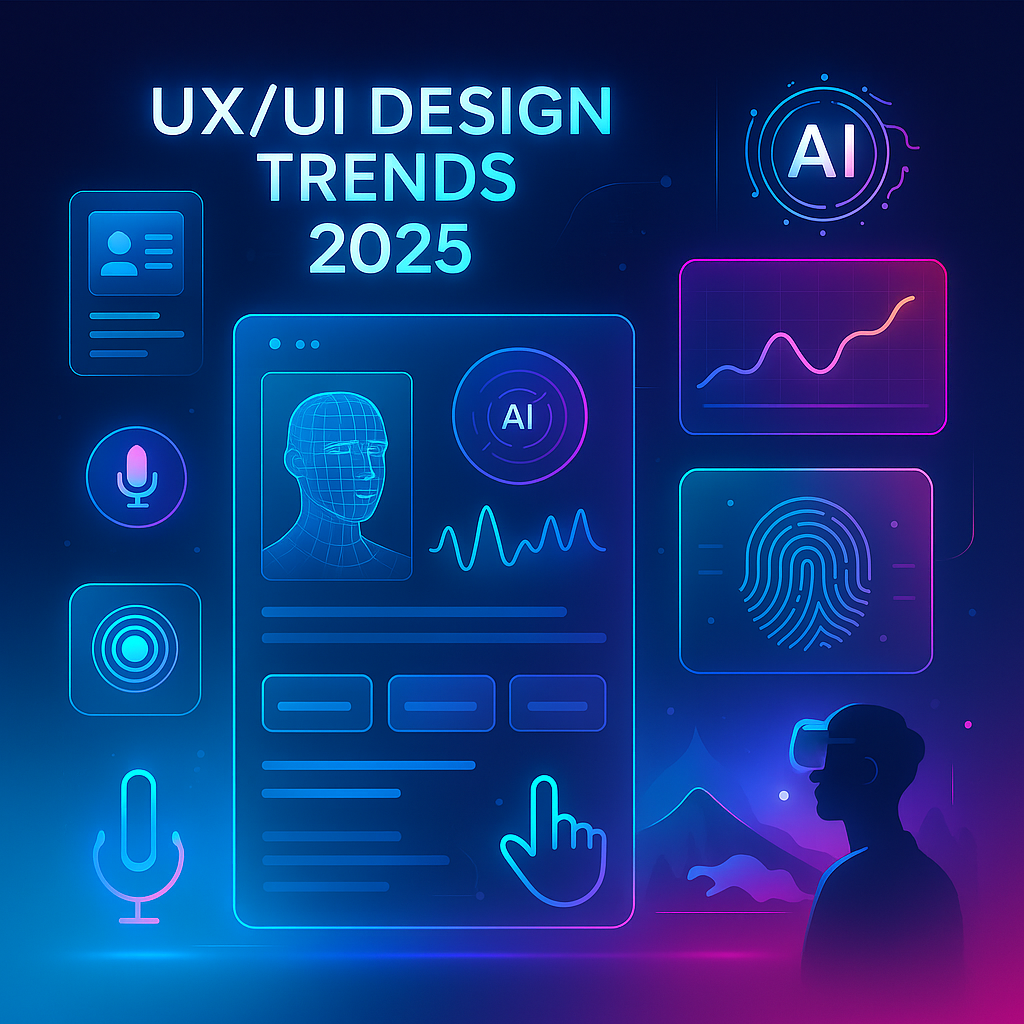
🌟 UX/UI Design Trends to Watch in 2025
As digital experiences evolve, 2025 is shaping up to be a revolutionary year for UX/UI design. With AI taking center stage and immersive technologies blending with minimalism, designers are rethinking the user experience from the ground up.
Whether you're a product designer, developer, or digital strategist, here are the top UX/UI trends to watch—and implement—this year.

1. AI-Powered Personalization & Predictive UX

AI is transforming how users interact with interfaces. From real-time content adaptation to predictive suggestions, the user journey is becoming smoother and smarter.
🔹 Predictive UX delivers content before users even search.
🔹 Platforms now adapt based on user behavior, preferences, and context.
🔹 Designers use AI to auto-generate design elements, freeing time for strategy.
2. Immersive 3D, AR & VR Interfaces
Forget flat screens—3D is in. From AR-enhanced shopping to full-on VR education platforms, immersion is the future of experience design.
🔹 Virtual Try-On is now a baseline in retail UX.
🔹 VR prototypes improve usability testing before launch.
🔹 Expect this to expand into healthcare, real estate, and training.
3. Voice & Gesture Interfaces
Touch isn’t the only way we interact with tech anymore.
🔹 Voice UIs are becoming more natural and intelligent.
🔹 Gesture navigation is showing up in wearables and smart home tech.
🔹 The shift to multimodal interaction enhances accessibility and UX for all.
4. Micro-Interactions & Motion Design
Details matter. Micro-interactions guide users, give feedback, and add delight.
🔹 Hover states, animated buttons, and subtle transitions improve clarity.
🔹 Parallax scrolling and motion effects create storytelling interfaces.
5. Soft UI: Neumorphism & Glassmorphism
Designers are moving away from flat minimalism to more tactile, sensory-friendly interfaces.
🔹 Neumorphism: Soft shadows and semi-3D controls for a cozy feel.
🔹 Glassmorphism: Transparent layers + blur for a futuristic vibe.
🔹 Apple’s new Liquid Glass UI is setting the tone for the next wave.
6. Bold Meets Minimal
Clean design is getting a splash of attitude.
🔹 Big typography and dynamic colors enhance readability and expression.
🔹 Gradients are back—but sleeker.
🔹 Less clutter, more meaning.
7. Accessibility & Ethical UX
Design is no longer just about aesthetics—it’s about equity.

🔹 WCAG compliance, screen reader support, and scalable interfaces are non- negotiables.
🔹 Dark mode and light-weight design improve sustainability.
🔹 Transparency and consent in UX help users trust your product.
8. Zero UI & Invisible Interfaces
The future of UX may be... nothing at all.
🔹 No buttons. No menus. Just predictive, context-aware design.
🔹 Think wearables, smart devices, and voice-first experiences.
9. Design Tokens & Modular Systems
Design systems are getting smarter and more scalable.
🔹 Use design tokens to control UI across multiple platforms.
🔹 Reusable components make updates faster and more consistent.
10. Emotion-Driven & Biometric UX
Technology is learning to feel—and respond.
🔹 Mood-based interfaces adjust based on user emotion.
🔹 Biometric data helps personalize experiences in real-time.
🔹 The result? Deeper user connection and trust.
🧠 Final Thoughts: The UX of the Future is Human-Centered
UX/UI in 2025 is about blending intelligence with intuition. It’s about creating experiences that are not only functional, but ethical, inclusive, and emotionally resonant.
🎯 Designers, it’s your moment: Think big, think immersive, and design for what users feel—not just what they do.
Contact Script Orbit today to revolutionize your mobile website experience!
This guide provides a decision framework, not a ranking, revenue or performance guarantee. Recommendations are reviewed against current business, audience, accessibility, search and technical context. Sources and standards are linked where they materially support a decision.